Build or buy is a decision about each process, and the answer for one process rarely carries over to the next. A tool that suits meeting summaries can be a poor fit for checking import documents, and a custom system that suits the second would be wasted effort on the first. A company-wide rule to buy everything, or to build everything, tends to leave value unused in one place and create avoidable risk in another.
This article sets out five questions that a business owner, a technology lead and a finance partner can answer together, followed by a scorecard for the steering meeting. It also covers the middle option that many enterprises overlook: buying a platform and configuring it around your process.
One disclosure before we start. Kreeda Labs builds custom AI systems for enterprises, so we have an interest in some of the answers below. We describe the cases where buying is the right choice as fully as the cases where building is, and we mark where a statement is our opinion.
Three options: buy, configure or build
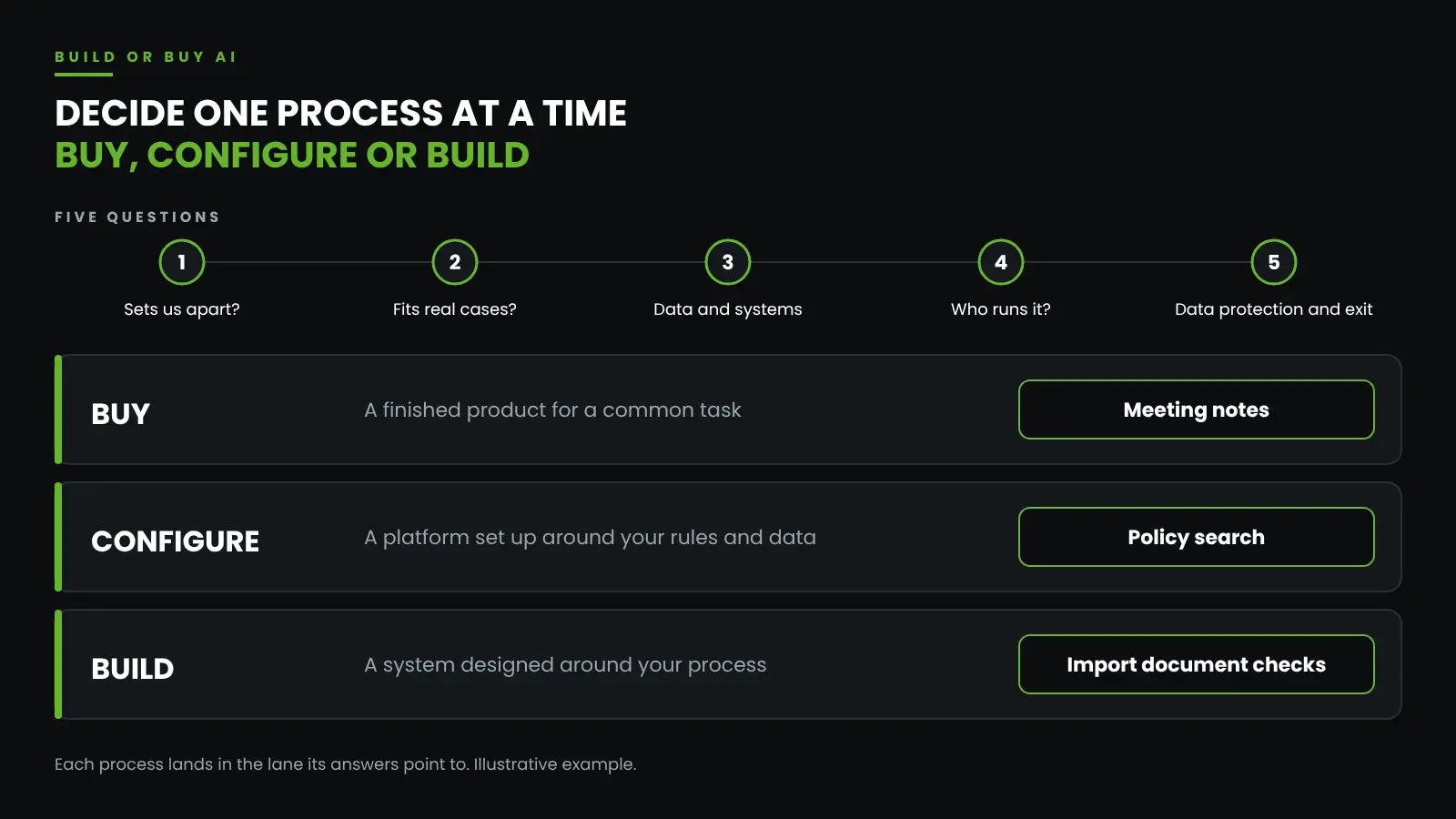
There are three realistic options, and the middle one is often where an enterprise should start. Buying means taking a finished product for a defined job. Configuring means taking a platform and setting it up around your own rules, data and systems. Building means designing a system around your process, either with an internal team or with a build partner.
| Option | What you get | Who owns the process logic | Where it fits best |
|---|---|---|---|
| Buy | A finished product for a defined job | The vendor | Common tasks that look much the same in every company |
| Configure | A platform that you set up around your rules, data and systems | Shared: the vendor owns the platform and you own the setup | Processes that are specific to you but made of standard parts |
| Build | A system designed around your process | You, or your build partner under contract | Processes that set you apart, or that have unusual data, integration or control needs |
In practice, building rarely means training a new model. It usually means building the application, the data pipeline, the evaluation and the integrations around models that already exist. That is a smaller and more predictable undertaking than the word suggests, and it changes the cost comparison. This is our reading of how enterprise projects are usually scoped.
Most enterprises end up with all three options across different processes. The decision becomes easier once each process is assessed on its own.
Five questions that decide the answer
The business owner of the process can answer each question below, with the technology lead checking the facts. None of them depends on how good a particular product is, which is a separate evaluation.
1. Does the process set the business apart?
Buying makes sense where the task is much the same in every company, such as summarising meetings, drafting routine replies or answering standard HR policy questions. A purchased product gives the same capability to your competitors, which is acceptable for common tasks. For a process that carries your own know-how, such as how you assess a supplier or price a custom order, the same property becomes a limit, and configuring or building keeps that know-how under your control.
2. How closely does a packaged product match the real process?
A demo shows a product at its best, so the useful test is a trial on your own material. Take a sample of real cases, including the awkward ones, and run them through the product as it would be used. If the business has to change how it works to suit the tool, or the team needs many workarounds for routine cases, the match is weak. A close match points to buying, a partial match to configuring a platform, and a poor match to building.
3. What do your data and systems look like?
Data held in one system that already has built-in AI favours buying, because the vendor has done the integration work. Data spread across several internal systems, or held in formats that vendors rarely support, such as scanned drawings, handwritten forms or documents in mixed languages, moves most of the effort into integration and preparation. That effort has to be paid for whichever option you choose, and it is easier to control when the system is configured or built around your data.
4. Who will be accountable for running it after launch?
AI systems need someone to check their output, handle exceptions and respond when a model or a process changes. Buying moves part of that work to the vendor, and the accountability for outcomes stays with your business. Building adds a requirement for a named technical owner and a support arrangement. If you have neither an internal team nor a partner under contract to run the system, building is the riskier option, and a smaller bought or configured product is the safer first step.
5. What are your data protection, audit and exit requirements?
Under India's Digital Personal Data Protection Act, 2023, a data fiduciary remains responsible for compliance when a data processor handles personal data on its behalf, irrespective of any agreement to the contrary (Section 8(1)), and may engage a processor only under a valid contract (Section 8(2)). Practical questions follow for every option: where the data is processed, whether it is used to train the vendor's models, which logs you can inspect, and how you take your data and configuration with you if you leave. A vendor who cannot answer these clearly points toward another vendor, a configured platform that you control, or a build. This is general information and not legal advice, and your counsel should review the contract terms.
The five questions on one page
When most answers lean the same way, the direction is clear. Mixed answers usually point to configuring a platform, which is our reading and not a rule.
| Question | Leans toward buying | Leans toward configuring or building |
|---|---|---|
| Does the process set you apart? | A common task, much the same in most companies | A process that carries your know-how or competitive edge |
| How closely does a product match the real process? | A close match on a trial with your own cases | Many workarounds, or the business would have to change how it works |
| What do your data and systems look like? | Data in one system that already has built-in AI | Data across several systems or in unusual formats |
| Who is accountable after launch? | The vendor runs the service and your owner checks outcomes | A named technical owner, or a partner under contract, is in place |
| What are your data protection, audit and exit needs? | Clear answers on where data is processed, training use, logs and export | Unclear vendor answers, or a need for control over logs and exit |
When buying is the right answer
Buying is the right answer for any task that is common across companies and that fits a packaged product on a trial. In our opinion this covers more of the AI an enterprise needs than a custom development studio would usually say, so we state it plainly. The clearest cases are:
- Company-wide productivity tasks, such as meeting notes, email drafting and search across documents in tools you already license.
- AI features built into software you already run, such as your CRM, HR system or service desk, where your process follows the product's standard flow.
- A first pilot where the aim is to learn what staff will actually use, and a quick start matters more than an exact fit.
- Teams that have no technical owner and no partner under contract to run a custom system.
Two checks keep a purchase sound. The first is a trial on real cases from your own process. The second is the set of exit questions under the fifth question above, covering data location, training use, logs and export. A purchase that passes both is rarely worth rebuilding.
When building is the right answer
Building is the right answer where the process is specific to your business and the value depends on how closely the system fits it. The clearest cases are:
- A process that carries your own know-how, such as how you qualify a supplier, price a custom order or judge a quality exception.
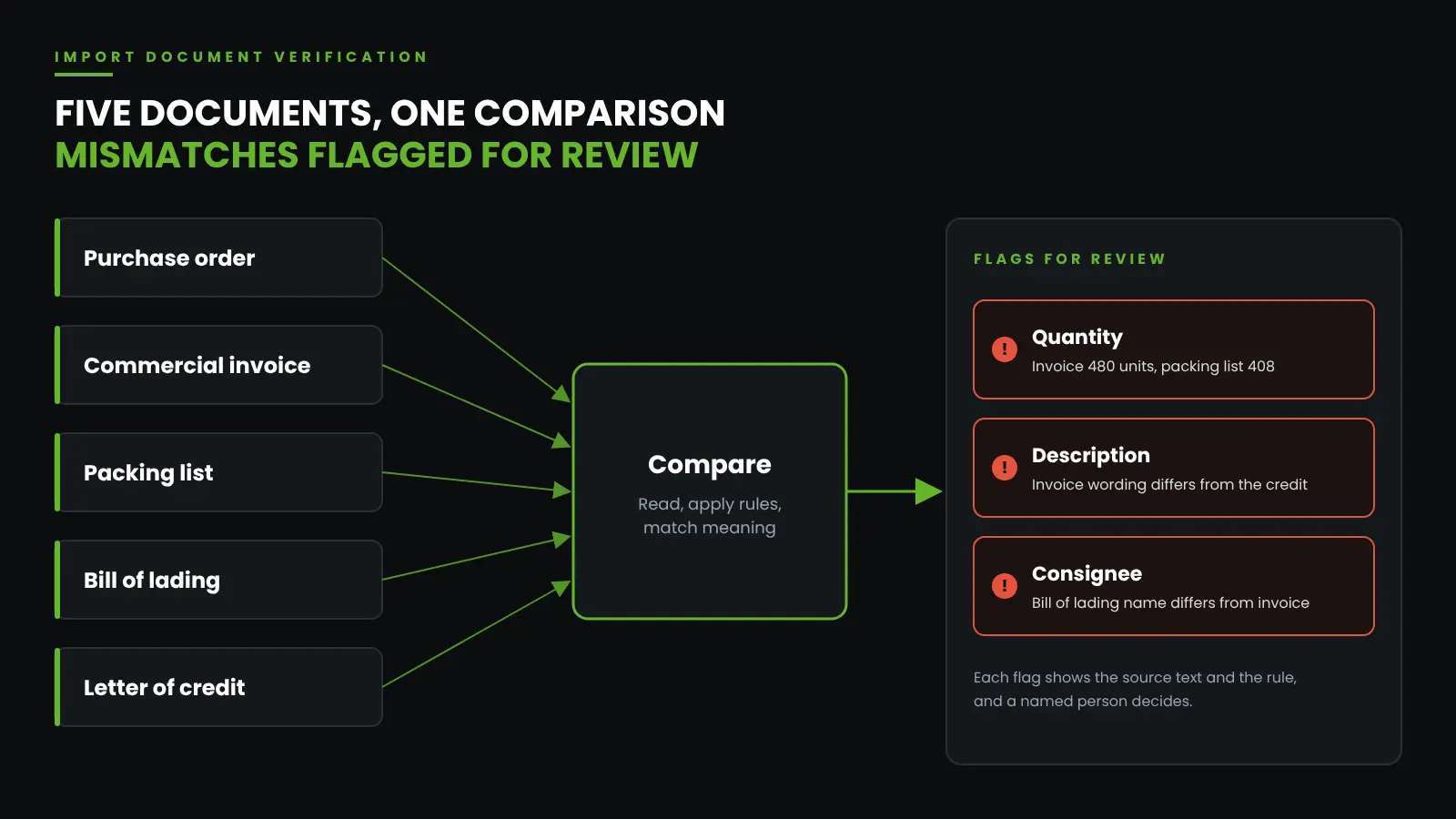
- Work with unusual inputs, such as engineering drawings, or a set of related documents that must be checked against each other, for example a commercial invoice, a packing list and a bill of lading.
- Strict control requirements, such as data that must stay in your own environment, a detailed audit trail, or tight connections to several internal systems.
- A capability that several processes or business units will reuse, where components built once lower the cost of each later use.
Building comes with conditions. It works best when there is a named process owner, a test set made from real cases and a plan for who runs the system afterwards. Without those three, projects tend to drift, and a configured platform is often the better starting point. One practical approach is to build in stages: start with the workflow where fit matters most, prove it on real cases, and extend from there.
Costs that are easy to underestimate
Both options carry costs that rarely appear in the first estimate, and they show up in different places. The table lists five of them so that each option can be costed over the same lines.
| Cost | Where it shows up when buying | Where it shows up when building |
|---|---|---|
| Evaluation | Testing the product on your own cases before launch and after vendor updates | Creating the test set and the scoring method |
| Integration | Connectors and data preparation, often charged as services | Custom connections to each internal system |
| Change over time | Vendor updates alter behaviour, so results need rechecking | Models, prompts and rules need maintenance by your owner or partner |
| Usage growth | Per-seat or per-use pricing rises as adoption grows | Model usage and hosting rise with volume |
| Switching | Moving data, configuration and staff habits to another product | Dependence on the team or partner that knows the system |
We suggest comparing the options over three years and filling in every line for each. A purchase that looks cheaper in the first year can cost more by the third if pricing scales with adoption, and a build that looks expensive at the start can work out cheaper if it replaces several licences. We have not given figures here, because they vary too much between processes to be useful as general numbers.
One company, three needs, three answers
To show how the questions work together, consider a hypothetical manufacturer with three AI needs. It is an illustration and does not describe any client.
| Need | Common to most companies? | Data and systems | Likely answer |
|---|---|---|---|
| Meeting notes and email drafting | Yes | Mostly inside tools the company already licenses | Buy |
| Search across internal policies and procedures | Partly | Documents spread over shared drives and a few systems | Configure a platform, and extend it if the fit proves weak |
| Cross-checking import documents against purchase orders | No, it depends on the company's own suppliers and products | Scanned and multi-language documents, linked to the ERP system | Build in stages, starting with the highest-volume document set |
The three needs give three different answers, and each follows from the five questions. A single company-wide rule would have been wrong for at least one of them.
A scorecard for the steering meeting
These eight questions can be put to the owner of any proposed AI project before a build or buy decision is signed off. A project that cannot answer them is not yet ready to be bought or built.
- Which process is this for, and who is its business owner?
- Is the task common across companies, or specific to ours?
- What did a trial on real cases from our own process show?
- Which systems and data does it touch, and has access been confirmed?
- Who is accountable for running it after launch?
- What are the vendor's or partner's answers on data location, training use, logs and export?
- What is the three-year cost of each option, including evaluation, integration and usage growth?
- What would make us stop or switch, and how would we know?
How we would approach it
We would start with the first two questions alongside the business owner, and ask for a sample of real cases before recommending any approach. Where a bought or configured product fits, we would say so, because a recommendation that serves the process is more useful to the client than one that serves our own project pipeline. Where the process is specific to the business, we would propose a staged build that begins with the workflow where fit matters most and checks its results on real cases before extending.
Summary
Build or buy is best decided one process at a time. Buy where the task is common and a product fits your real cases, configure a platform where the process is yours but made of standard parts, and build where the process sets you apart or has unusual data and control needs. Five questions, a three-year cost comparison and a short scorecard let the business owner, the technology lead and the finance partner reach the same answer. Kreeda Labs can review a specific process against these questions with your team.
This article is general information about planning AI projects and is not legal, financial or procurement advice. Contract and data protection terms should be reviewed by your own advisers.
FAQ
What is the difference between building and buying AI?
Buying means taking a finished product for a defined job. Building means designing a system around your own process, with an internal team or a build partner. A third option, configuring a platform around your rules and data, sits between the two.
Does building AI mean training our own model?
Usually it does not. Most enterprise builds create the application, data pipeline, evaluation and integrations around models that already exist.
Is it cheaper to buy or to build enterprise AI?
It depends on the process. Compare each option over three years, including evaluation, integration, usage growth and switching costs, because the cheaper option in year one is not always the cheaper one in year three.
Who is responsible if a vendor processes our customers' personal data?
Under Section 8(1) of India's Digital Personal Data Protection Act, 2023, the data fiduciary remains responsible for compliance when a data processor acts on its behalf. Contract terms should be reviewed by your own advisers.