
AI vs ML Explained: Definitions, Differences, and Applications

Most people hear “AI” and “ML” and assume they mean the same thing. It happens everywhere. Students preparing for their first tech interview say it. Business teams planning a new feature say it. Even founders use both terms interchangeably when they pitch new ideas.
It creates confusion. Not because the concepts are hard, but because both words appear together in every article, every product launch, and every conversation about the future of technology. So, the lines blur quickly.
This small confusion can slow down decision-making. Product and business teams may expect one thing while the technical team builds something completely different. Leaders may think they need “AI” when their actual requirement is much simpler. On the other hand, teams may underestimate the effort behind building systems that learn from real data.
This blog clears up that confusion in a practical way, helping teams understand the difference between AI and ML so they can communicate better, plan better, and choose the right approach for their use case.
What is Artificial Intelligence?
Artificial Intelligence is the idea of getting machines to perform tasks that usually need human thinking. It is a broad space. Anything that tries to mimic decision-making, perception, or problem-solving comes under AI.
At its core, AI focuses on one simple question: can a system take in information and respond in a smart, goal-driven way.
AI does not always rely on large datasets or advanced algorithms. Many AI systems follow clear rules written by humans. Some use logic, pattern matching, or simple decision trees to choose the next action. These systems may not learn on their own, but they still behave intelligently within the limits set for them.
Some everyday examples include:
Voice assistants responding to commands
Routing systems choosing the best path
Chatbots answering common queries
Automated checks on production lines
All these examples qualify as AI because they mimic some form of reasoning or guided action.
Now that AI is clear, let’s get into Machine Learning, which is a more specific part of this space.
What is Machine Learning?
Machine Learning is a specific branch within AI that focuses on learning from data. Instead of following fixed rules, an ML system improves its output by studying examples, patterns, and past outcomes.
The simplest way to think about ML is this. You feed the system data, it finds patterns on its own, and it uses those patterns to make predictions or decisions. The more relevant data it gets, the better it becomes.
Unlike many traditional AI systems that depend heavily on instructions written by humans, ML systems adjust their behavior based on experience. This makes them useful for tasks where rules are hard to write but patterns are easy to learn from real-world information.
Common examples include:
Email filters that identify spam
Recommendation engines that suggest what to watch or buy
Credit scoring models
Image classification systems
These systems do not just follow a static checklist. They learn from large amounts of data, improve over time, and adapt when new information comes in.
Now that both ideas are clear on their own, it becomes easier to compare them side by side. Let’s move to the next part where we highlight the key differences.
What is the Difference Between AI and ML ?

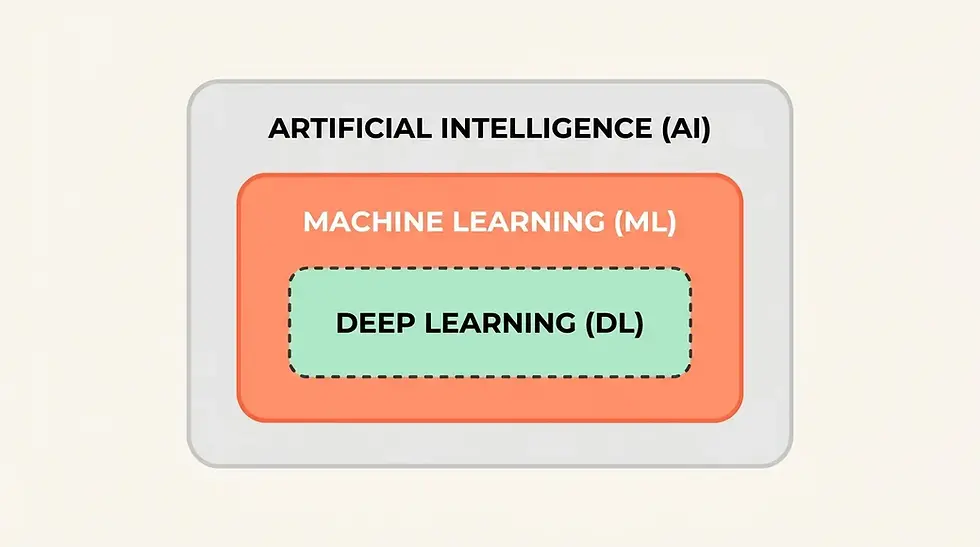
AI and ML often sit in the same conversations, but they operate at different levels. AI is the broader goal, while ML is one of the main ways to achieve that goal.
Here are the core differences that help teams understand what they actually need:
AI vs ML: Quick Comparison Table
Aspect | Artificial Intelligence (AI) | Machine Learning (ML) |
Scope | Covers all techniques that make machines behave in a smart or goal-oriented way. | Focuses only on learning from data. |
How Decisions Are Made | Uses rules, logic, search methods, or predefined instructions. | Learns from past data and improves over time. |
Data Dependency | Can work with or without large datasets, depending on the approach. | Always depends on data because learning drives the system. |
Adaptability | May not adapt unless explicitly programmed. | Continuously adapts as more data becomes available. |
Common Use Cases | Chatbots, rule-based engines, robotics, planning systems. | Fraud detection, recommendations, forecasting, image recognition. |
Output Style | Mimics reasoning or structured decision-making. | Produces predictions, classifications, or pattern-based insights. |
To make it more practical for readers, we can now move to real examples where AI and ML behave differently in the real world.
Applications of AI
AI appears in many systems that need structured decision-making, controlled logic, or automated actions without heavy learning requirements. These applications focus on simulating smart behavior using rules, logic, workflows, or predefined strategies.
1. Rule-Based Chatbots and Virtual Assistants
These bots answer common questions, guide users through steps, and trigger actions based on predefined flows. They don’t learn from past chats but still automate a big part of support.
2. Automated Quality Checks
In many factories, AI systems follow fixed rules to identify faulty units, verify measurements, or approve items in an assembly line.
3. Intelligent Routing and Planning
Systems that calculate shortest paths, allocate resources, or manage scheduling often rely on AI logic instead of learning models.
4. Robotics and Process Automation
Robots follow structured instructions to perform tasks like picking, assembling, or sorting. The intelligence comes from rules and sensors, not learning.
5. Document Classification Using Rules
Organizations often build workflows where AI identifies document types using set conditions instead of ML models.
AI works best where decisions are predictable, rules are clear, and the environment doesn’t require adaptation based on past data.

Want These AI Capabilities in Your Product?
Kreeda Labs can build the same for your internal systems and customer-facing apps — fast, practical, and aligned with your goals.
Applications of Machine Learning
ML shines in environments where patterns matter, data changes over time, and predictions improve with experience. These systems adapt, learn, and adjust without rewriting the rules manually.
1. Fraud Detection
ML models scan thousands of transactions, detect unusual behavior, and adapt as new fraud techniques appear.
2. Recommendation Systems
Ecommerce, OTT, and travel platforms use ML to study user behavior and suggest products, movies, or destinations that match individual preferences.
3. Demand Forecasting
Retailers and supply chains use ML to predict inventory levels, seasonal demand, and purchase patterns based on past data.
4. Predictive Maintenance
Machines generate vibration, temperature, and performance data. ML finds early signs of failure long before humans can detect them.
5. Image and Voice Recognition
ML learns to identify faces, detect objects, understand speech, and convert audio into text by training on large datasets.
ML works best where the system must learn from real-world examples and improve as more data comes in.
Before talking about what organizations should choose, it helps to look at how both technologies actually work together inside real products and internal systems.
How Companies Use AI and ML Together
1. Customer Support Automation
Companies often combine AI logic with ML models to streamline customer support.
ML’s role: Understands user queries using intent classification, sentiment analysis, and past chat patterns.
AI’s role: Decides what action to take. For example, trigger a refund step, fetch an account detail, or hand the case to a human.
This mix ensures that the chatbot not only understands the customer but also responds with the right next step. The ML part handles interpretation, while the AI part handles decision flow.
2. Predictive Maintenance in Manufacturing
Factories rely heavily on machine data, and both AI and ML contribute in different ways.
ML’s role: Learns from vibration data, temperature changes, and equipment history to identify patterns that signal potential failure.
AI’s role: Uses those predictions to schedule downtime, trigger alerts, or reroute production tasks.
ML does the prediction. AI handles the broader decision-making around what to do with that prediction.
3. Fraud Detection in Finance
Banks and fintech companies depend on layered systems where AI and ML work in sync.
ML’s role: Analyzes thousands of transaction patterns, flags unusual activity, and updates its understanding as new fraud types appear.
AI’s role: Applies business rules, calculates risk scores, and decides whether to block, review, or approve a transaction.
ML identifies the risk. AI governs the response.
4. Personalized Recommendations in Retail and OTT Platforms
Retailers and streaming platforms use layered intelligence to enhance user engagement.
ML’s role: Learns from browsing behavior, purchase patterns, watch history, and micro-interactions.
AI’s role: Decides what to show first, what to bundle, what to promote, or when to send a reminder.
ML learns preferences. AI manages the experience.
5. Hiring and Candidate Screening
Companies use smart hiring tools where both systems play separate roles.
ML’s role: Reads resumes, identifies skills, analyzes past hiring data, and ranks candidates.
AI’s role: Applies job-specific rules, filters candidates based on must-have criteria, and assists recruiters with recommendations.
ML handles pattern recognition. AI handles the selection logic.
Now that the real use cases are clear, the next step is understanding why this distinction actually matters inside an organization. It affects planning, budgeting, timelines, and even how teams communicate requirements.
Why This Difference Matters for Organizations
1. Clearer Project Scoping
Many projects get stuck because teams ask for “AI features” without knowing what that means. Understanding the difference helps product owners express whether they need a rule-based intelligent flow or a data-driven learning system.
When teams know the distinction:
Requirements become clearer
Effort estimation becomes realistic
Dependencies are visible from day one
2. Accurate Budget and Timeline Planning
AI systems that rely on fixed rules often take less time and fewer resources. ML systems need data pipelines, training cycles, model testing, and monitoring.
Knowing which one your project needs helps leaders:
Plan budgets properly
Avoid overpromising
Prevent last-minute rebuilds
3. Better Talent Allocation
AI-heavy projects may need strong business logic and domain expertise. ML-focused projects need data engineers, model developers, and people who understand datasets.
When companies mix up the two, hiring becomes messy and teams struggle to deliver.
4. Reduced Miscommunication Between Business and Tech Teams
If business teams say “We want AI that predicts customer behavior,” tech teams may assume the need for ML, but what the business actually wants might be a simple rules engine.
Clarity here avoids:
Rework
Feature mismatches
Misaligned expectations
5. More Informed Decision-Making
Understanding the difference helps leaders pick the right tool for the right problem. Some situations truly need ML. Others can be solved faster with AI logic. In some cases, combining both gives the best result.
This clarity leads to smarter product decisions and faster execution.
Before we wrap up the differences, it helps to clear a few common misunderstandings. These misconceptions often slow down discussions inside organizations and lead to unrealistic expectations.
How Organizations Should Choose Between AI and ML
Before selecting any solution, teams first need clarity on what they’re solving for. Most confusion happens because both AI and ML sit in the same ecosystem, but they serve different purposes inside a product or internal workflow.
Choosing the right one isn’t about trend-hunting, it’s about what the business actually needs.
Here’s a simple way organizations can decide.
1. Start With The Problem, Not The Technology
The first question should be:
“Do we need the system to reason, or do we need it to learn from patterns?”
Examples:
If the goal is to automate decision-making that follows, clear rules → AI rule-based systems are enough.
If the goal is to learn from historical data and improve accuracy over time → ML is a better fit.
This helps avoid over-engineering.
2. Understand Whether Historical Data Is Strong Enough
Machine learning only works if the business has high-quality, labelled data. AI does not always need such data.
Ask:
Do we have consistent past records?
Are the labels reliable?
Is the volume sufficient for a model to learn?
If not, ML may produce unstable output and AI logic-based solutions might be more practical in early stages.
3. Check The Level of Unpredictability in Decision-Making
If business decisions:
follow fixed steps,
require clear instructions,
have low tolerance for error,
→ AI automation (non-ML) is suitable.
If decisions:
depend heavily on changing user behaviour,
require pattern discovery,
benefit from continuous improvement,
→ ML is the right direction.
4. Consider Speed of Deployment Vs. Long-Term Adaptability
AI systems (non-ML) are:
faster to build
cheaper to deploy
easier to control
ML systems are:
slower initially
more powerful long-term
able to adapt to new data continuously
Organizations should pick based on whether they need value quickly or need a solution that keeps learning.
5. Evaluate Risk, Compliance, And Explainability
Industries like finance and healthcare require models to be transparent.
If the team must explain every decision → Use AI logic-based systems.
If explainability can be balanced with performance and you're able to monitor the model → ML works well, especially with supervision tools.
6. Look At Available Engineering Capacity
AI automation often requires:
clear rules,
domain expertise,
software engineering.
ML solutions require:
data engineers,
data scientists,
model monitoring infrastructure.
Many teams choose ML without realizing they don’t have the ecosystem to maintain it.
7. Combine AI And ML When The Problem Benefits From Both
Some use cases need:
ML for predictions
AI systems for decision logic
Business rules to tie everything together
Examples include:
underwriting engines
fraud detection platforms
intelligent customer support
personalization engines
In these cases, choosing “AI vs. ML” isn’t the point — choosing the right combination is.
Common Myths and Misconceptions
1. “AI and ML are The Same Thing”
This is the biggest one. AI is the broader goal of making systems act intelligently. ML is one of the methods used to achieve that. Not every AI system learns from data.
2. “ML Automatically Improves Without Effort”
Many teams assume an ML model keeps getting smarter on its own. In reality, it needs clean data, regular updates, retraining sessions, and monitoring. Without this, performance drops.
3. “AI Always Needs a Huge Amount of Data”
Not true. Only ML depends heavily on data. Many AI systems run perfectly with rules, logic, and predefined flows.
4. “More Data Always Means Better ML Results”
Quality matters more than size. Poor or outdated data can damage accuracy, even if the dataset is large.
5. “AI Will Replace all Decision-making”
AI supports decisions, highlights patterns, and reduces manual work. It does not remove the need for human judgment, especially in critical areas like healthcare, finance, or policy.
Now that the decision-making framework is clear, the next question is usually the toughest one — “How do we actually bring AI or ML into our company without turning everything upside down?”
That’s where the real work begins, and it’s also where the right partner can make a noticeable difference.
Operationalizing AI and ML With Kreeda Labs
Most organizations know they need AI and ML, but the real challenge is figuring out how to bring these capabilities into existing systems without breaking what already works. That’s exactly where Kreeda Labs fits in to help teams move from scattered ideas to working, reliable intelligence inside their products and internal processes.
1. Clarifying where AI or ML actually adds value
Instead of pushing every use case toward ML, Kreeda Labs helps teams identify where:
AI logic is enough,
ML is worth investing in, or
a hybrid model delivers the highest ROI.
This removes the guesswork that usually slows down AI adoption.
2. Auditing your existing workflows and data
Many organizations try building models before checking whether their data supports it. Kreeda Labs runs a structured audit to evaluate:
data quality and gaps,
process bottlenecks,
where automation can reduce manual load,
where predictions can improve decisions.
This ensures teams don’t end up building models that fail in production.
3. Designing AI/ML workflows that fit your business rules
No two companies operate the same way. Kreeda Labs helps create workflows that match real operational constraints — approval hierarchies, risk rules, compliance checks, exception handling, and human oversight.
The result is AI that works in the real world, not just in a lab notebook.
4. Building and deploying models that stay stable over time
Model stability is one of the biggest operational pain points. Kreeda Labs focuses on:
selecting the right model type,
tuning for performance,
monitoring drift,
adding guardrails so the system doesn’t break when behaviour changes.
This ensures the intelligence layer remains reliable as user patterns evolve.
5. Integrating AI/ML into your existing systems
Implementation isn’t just about the model — it’s about embedding it into your ecosystem.
Kreeda Labs supports integration with:
CRMs and ERPs,
internal dashboards,
decision engines,
data pipelines,
user-facing applications.
This helps companies put AI into actual use, not keep it stuck in POCs.
6. Ensuring scalability and long-term maintainability
Teams often adopt AI without planning for scale. Kreeda Labs builds solutions with clear attention to:
compute growth,
model updates,
data expansion,
maintenance workflows,
cost-efficiency.
This ensures companies don’t feel the pressure of AI infrastructure years down the line.
7. Supporting teams with training and ongoing guidance
AI adoption works best when internal teams understand how to work with the new system. Kreeda Labs helps by offering:
model usage training,
guidance on updating workflows,
documentation,
support for future upgrades.
This helps organizations operate confidently, even as the system evolves.
If you’re planning your next AI or ML step, do it with clarity.
Kreeda Labs can help you map the right approach, design a reliable solution, and bring it to production with confidence.
FAQs
1. What is the main difference between AI and Machine Learning?
AI focuses on creating systems that mimic human-like decision-making, while ML focuses on learning patterns from data to improve predictions or decisions.
2. Is Machine Learning a part of Artificial Intelligence?
Yes. ML is a subset of AI. AI is the broader concept, and ML is one of the ways AI is achieved.
3. Can AI work without Machine Learning?
Yes. Many AI systems use rule-based logic, knowledge graphs, or deterministic workflows without relying on ML algorithms.
4. Why do companies use AI and ML together?
Because AI handles reasoning and decision workflows, while ML improves those decisions through data-driven predictions. Together, they allow automation + intelligence in one system.
5. Which is better for business: AI or ML?
It depends on the problem. If the workflow follows clear rules, AI is enough. If a system must learn from historical data and improve over time, ML is the right choice.
6. Does Machine Learning require a lot of data to work?
Yes. ML relies on historical data to spot patterns. The more accurate and consistent the data, the better the model performs.
7. How can an organization decide whether to use AI or ML?
By evaluating the problem scope, data availability, risk level, decision complexity, and long-term scalability needs. A structured assessment helps teams choose the right approach.
8. What is the difference between an AI Engineer and an ML Engineer?
An AI engineer builds full intelligent systems that handle reasoning and decisions, while an ML engineer focuses on developing and deploying the machine learning models inside those systems.
9. What is the difference between AI, ML, and Data Science?
AI creates intelligent behavior, ML learns patterns from data, and Data Science analyzes data to generate insights. Data Science explains, ML predicts, and AI uses those predictions to automate actions.
10. What is the difference between AI, ML, and Deep Learning?
AI is the broad field; ML is a subset that learns from data, and Deep Learning is an advanced form of ML using neural networks for complex tasks like image or speech processing.


Comments