
The Plausibility Debt Problem: Why AI Systems Fail Without Ever Looking Broken


A recruitment technology team logs in on a Tuesday morning, and everything looks fine. The AI-based candidate screening system is running. Dashboards are green. No errors in the logs, no failed requests, no angry tickets from recruiters. The system has been scoring and ranking incoming resumes against open roles exactly as it was built to do, all week, without interruption. What nobody notices is that the same resume, submitted twice within the same hour against the same job requisition, has produced two different shortlist outcomes. Nothing crashed. Nothing alerted. The system simply gave a different answer the second time, as confidently as it had given the first.
A Different Kind of Failure
Conventional software fails in ways organisations have spent decades learning to detect. A payment fails, a transaction times out, a server returns a 500 error, and someone is paged. The failure announces itself. AI systems built on large language models rarely offer that courtesy. They do not crash when something goes wrong; they degrade. An output remains fluent, well-formatted, and confident, sounding even when it is inconsistent with the same system's own output from an hour earlier. The screening system in the scenario above never stops working. It simply stops being reliable, and reliability is not something most monitoring dashboards are built to measure.
This is the structural reason silent failure is so dangerous in production AI systems: the surface signals organisations have learned to trust, uptime, response time, and absence of errors, say nothing about whether the underlying judgement is correct or repeatable. A relationship manager at a bank using an AI assistant to summarise a client's portfolio risk will get a clean, well-written summary every time, whether or not that summary reflects the same conclusion the same assistant would have reached yesterday on identical data. There is no exception thrown when an LLM's output drifts. There is just a slightly different answer, delivered with exactly the same tone of certainty as the correct one.
This gap between how trustworthy an output looks and how trustworthy it actually is can be called plausibility debt. Every time a system produces an output that sounds right without anyone verifying that it is right, a small amount of that debt accrues. Unlike technical debt, which usually announces itself eventually through slower development or brittle code, plausibility debt stays invisible because the system keeps producing plausible-looking results. It does not get called due until a decision is made on a flawed output that collides with reality.
What Non-Determinism Actually Costs the Business

The financial impact of this problem is rarely modelled, largely because it does not show up as a line item the way an outage does. Consider a recruitment operation processing five thousand candidate profiles a month through an AI screening layer. If even ten percent of those evaluations carry scoring inconsistencies significant enough to change a candidate's shortlist status, not a wild error, just enough variance to move someone from a borderline “yes” to a borderline “no” on a re-run, that is five hundred candidates a month whose outcome depended on which version of the answer the system happened to produce that day.
If recruiters or hiring managers eventually notice something is off and spend even fifteen extra minutes per flagged case manually re-checking a score, that is over a hundred hours of skilled labour a month spent re-verifying a system that was supposed to remove exactly that workload. That figure does not include the harder cost to quantify: a strong candidate quietly filtered out, a hiring manager who starts overriding the system entirely because they no longer trust it, or a compliance question about why two comparably qualified applicants were scored ten points apart for reasons nobody can reconstruct.
The timing of discovery matters as much as the inconsistency itself. A scoring discrepancy caught in the first week of deployment is a debugging task, a missing configuration setting, an unstable sampling parameter, or a batching process that lets one candidate's evaluation be subtly influenced by another's. The same discrepancy discovered three months later, after dozens of hiring decisions had already been made on its output, is a credibility crisis. By then, the plausibility debt has compounded past the point where a quiet fix resolves it; the organisation is left explaining decisions it cannot fully defend, to people who reasonably assumed the system was consistent because nothing ever told them otherwise.
Why Teams Don't Catch It, and What Closes the Gap
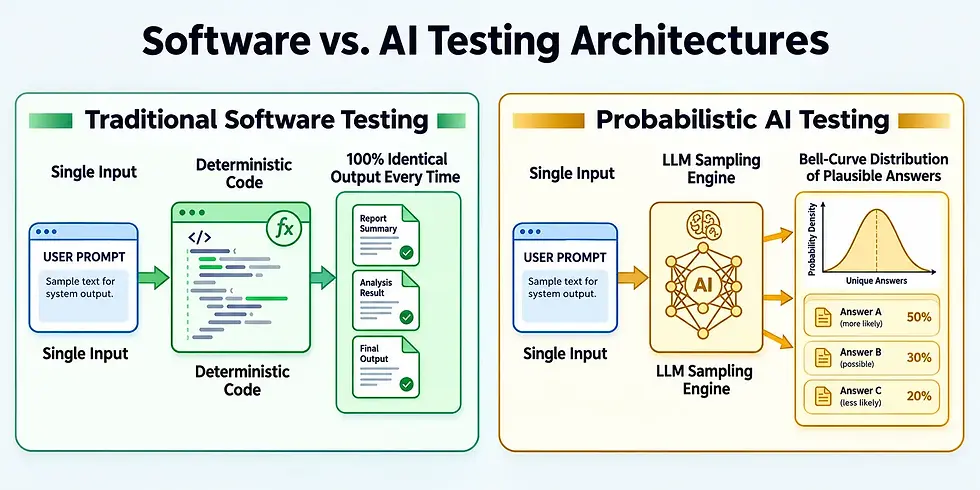
Part of the reason this debt accumulates unnoticed is psychological rather than technical. Engineering teams are trained, reasonably, to trust systems that are not throwing errors. A pipeline that runs to completion without exceptions looks like a pipeline that is working correctly, and for decades in conventional software, that assumption has largely held. Probabilistic systems break that assumption quietly, and most evaluation frameworks have not caught up. Many teams validate an LLM-based system once, against a fixed test set, before launch, and treat a passing score as a permanent property of the system rather than a snapshot of one moment in time, under one set of conditions, that may never recur the same way again.
The second part of the gap is an absence of the right kind of testing. Conventional QA asks whether a system produces the correct output. Probabilistic systems require a further question: does the same input produce the same output, consistently, across repeated runs, model versions, and load conditions? Closing this gap means treating LLM outputs the way engineers treat data from a physical sensor—inherently noisy, requiring calibration, and never assumed accurate simply because a reading was returned. That means building behavioural tests that rerun identical inputs to measure variance rather than testing accuracy once and walking away. It means setting explicit thresholds for acceptable output variance rather than relying on a single pass or fail. It means building feedback loops that connect what happens downstream—the hiring manager who overrode a score, the customer who escalated a wrong answer back to the evaluation process, so plausibility debt gets surfaced and paid down before it compounds further.
Silent failure in AI systems is not, at its core, a model quality problem. It is a measurement problem. The technology is doing exactly what probabilistic systems do: producing a distribution of plausible answers rather than one guaranteed correct one. The organisations that get hurt by this are not the ones whose models are weakest; they are the ones who never built a way to notice when the same question stopped producing the same answer. Before the next AI system goes into production, the more useful question may not be how accurate it is, but how anyone would know if it quietly stopped being consistent, and how long that would take to surface.


Comments