

One Student, One Path, One Plan: An AI Learning Engine for Grades 6 to 10
How an AI learning engine replaced the one-size-fits-all classroom for CBSE and ICSE students, recomputing what each student personally needs to study every single morning.
The impact
A new plan every morning
A ranked daily plan is recomputed for every active student at 5 AM, built from that student's own topic-level evidence rather than a shared curriculum calendar. Grades 6 to 10, CBSE and ICSE, across Mathematics, Physics, Chemistry and Biology.
At a glance
The project in four answers
What was the problem?
India's K-12 classrooms teach at one pace to one syllabus, so an individual student's gap inside a chapter stayed invisible and revision was generic rather than evidence-driven.
What did Kreeda Labs build?
An AI-native learning platform for Grades 6 to 10 that tracks each student's real classroom position, models understanding at topic level and recomputes a ranked daily study plan every morning.
Which technologies were used?
Node.js, Express and TypeScript on PostgreSQL, Azure Service Bus and Functions, a Python FastAPI service calling GPT-4o-mini for written answers, and Bayesian Knowledge Tracing for knowledge modelling.
What was the outcome?
Topic-level personalisation with no lag between a graded test and the next day's plan, continuous parent visibility, and an architecture that absorbed mastery, recommendation and AI companion modules without rewrites.
Project overview
Every student in a Grade 9 Biology class receives the same lecture, the same homework and the same exam, whether they mastered mitochondria last week or are still confused about the nucleus.
This project covers the design and build of an AI-native learning platform for students in Grades 6 through 10, studying under India's CBSE and ICSE boards, across Mathematics, Physics, Chemistry and Biology.
The platform was never built to replace school. It sits alongside it, following the exact chapters a student's school is teaching week by week, while continuously deciding what that student personally needs to study today, which concepts need revision, which topics are already mastered and which are quietly slipping. Every test, session, mistake and improvement becomes a data point that reshapes the next day's plan, so no two students in the same class studying the same chapter are guaranteed the same set of tasks.
The founding team paired more than 15 years of classroom and tuition-centre experience with over 30 years of enterprise technology leadership and a US-based digital transformation advisor, giving the project both pedagogical grounding and the engineering discipline to build a system meant to run for years rather than a semester.
The challenge
When One Lesson Plan Has to Fit Every Mind in the Room
India's K-12 EdTech market is large and growing quickly, yet a competitive review of its best-known platforms found none that combined AI-driven personalisation, written-answer evaluation, structured study planning and emotional support in one coherent product.
One Lesson Plan for Every Mind in the Room
Every student receives identical lectures, homework and tests, so an individual misunderstanding of one topic inside a chapter stays invisible to the system teaching them. Weaknesses compound silently because nothing tracked understanding below chapter level.
No Clarity on What to Study, or When
Without a ranked daily plan, students and parents were left guessing which chapter, sub-chapter or topic deserved attention. Effort was high and direction was missing, and revision, where it existed at all, was generic rather than evidence-driven.
Marks Without Insight
Marks-only feedback with no visibility into readiness left students anxious rather than prepared. A poor score read as a verdict on ability instead of a specific, solvable gap, and progress stayed invisible to parents between report cards.
Classrooms That Refuse to Keep to Schedule
School pacing is neither standardised nor predictable. Chapters start late, get interrupted and run out of order, yet the platform had to track each student's true classroom position without manual administration.
Two Grading Speeds, One Session
Objective questions needed instant deterministic grading. Written answers needed AI evaluation with reasoning. Neither could be allowed to block or break a student's test session if a service failed.
Modelling Knowledge, Not Just Marks
A single test score is a noisy, one-time signal. The system needed a model of true understanding that accounted for history, momentum and forgetting, on an architecture that could absorb years of new modules without collapsing.
What Kreeda Labs built
A Closed-Loop, Topic-Level Personalisation Engine
Eight modules, each owning its own data and rules, answering one question every morning for every student: what does this student need today?
Modular Monolith Architecture
One deployable application organised into independent business modules, each owning its own data and rules and communicating only through Reader and Facade interfaces for synchronous reads and domain events for asynchronous reactions. Clean boundaries without distributed-system overhead, and a clear extraction path for any module that later needs to become its own service.
Curriculum as the Knowledge Spine
A strict hierarchy of Board, Standard, Subject, Chapter, Sub-Chapter and Topic anchors every note, flashcard, objective question and written question. Topic is the smallest unit in the platform and the foundation everything else personalises against. Authentication and subscription sit alongside it, deliberately unaware of academic logic.
Syllabus Tracking and the Two-Phase Chapter
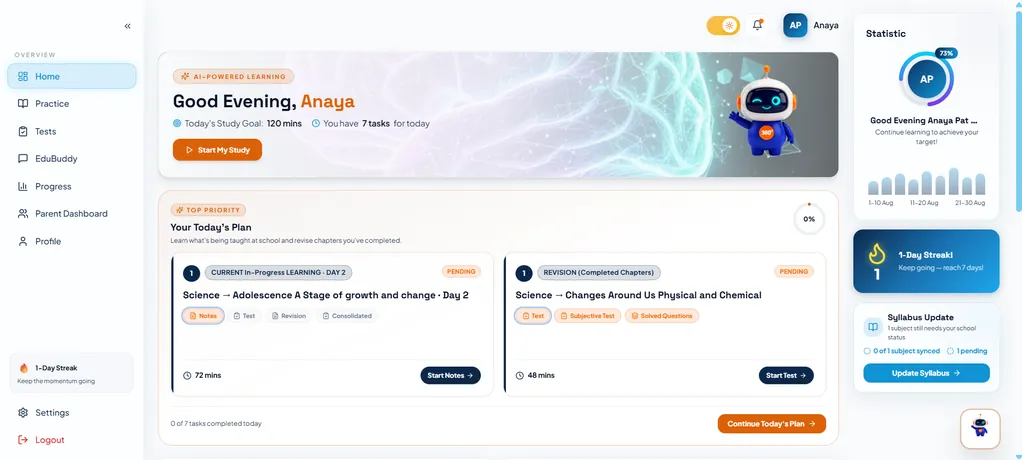
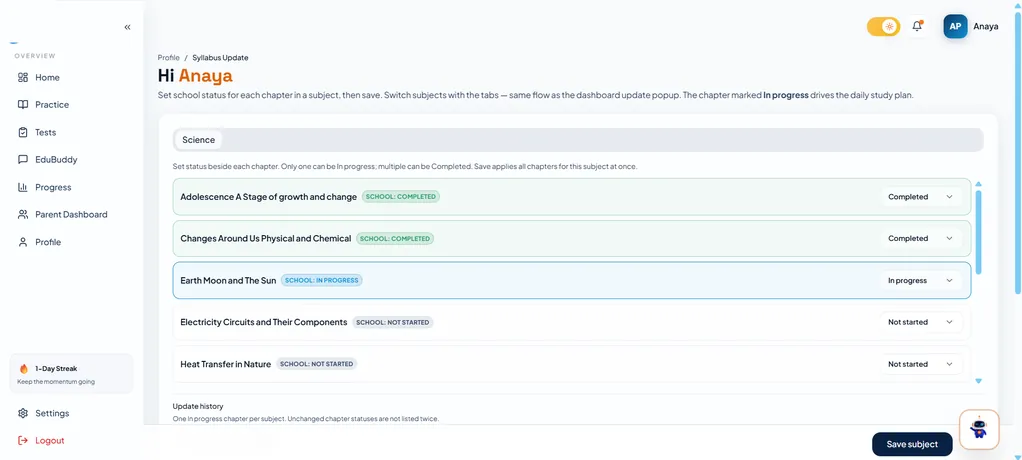
A mandatory Monday and optional Thursday check-in keeps each student's active chapter aligned with what their school is actually teaching. If the school moves on mid-chapter, the old chapter is interrupted and preserved in an ordered backlog rather than lost. Phase 1 runs a school-paced pipeline of notes, tests and cumulative revision; once the final consolidated test completes, the chapter moves into Phase 2 reinforcement.
The Task Engine
The daily planning brain. In Phase 1 it distributes a chapter's topics evenly across the school's teaching timeline. In Phase 2 a what-to-study ranking engine runs on a 5 AM cron for every active student, scoring every eligible sub-chapter on learning gap, topic complexity weighted by the student's own performance category, recency of teaching, recent trend and study efficiency, then issuing a fixed daily task set split across a primary and secondary subject. Unfinished tasks and interrupted chapters queue into backlogs and resurface when priority allows.
The Test Engine
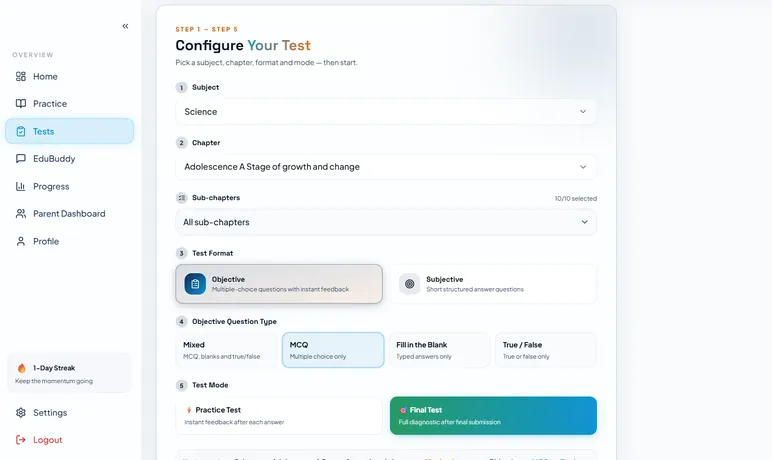
Manages the full session lifecycle for both question types. Objective formats are graded instantly and deterministically. Written answers go to an external AI evaluation service with the subject, chapter, class level and model answer, and return a score out of 100 with written reasoning. Every graded test publishes one structured result per topic covered rather than a single overall score.
The Mastery Engine
Estimates true topic-level understanding using Bayesian Knowledge Tracing blended with a momentum signal built from an exponential moving average of recent performance. This separates a student who scored well once from one who has shown durable understanding over time, and marks and mastery stay related but distinct concepts throughout the platform.
Recommendation Logic and the AI Companion
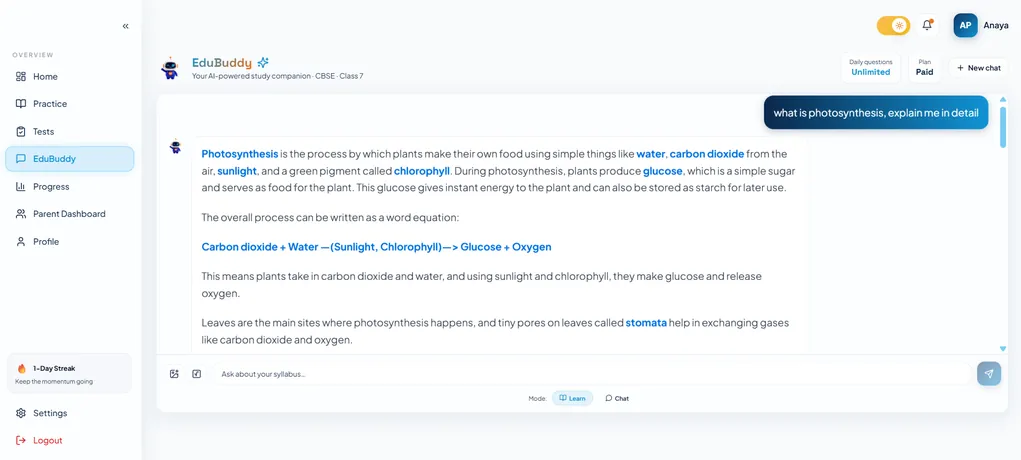
Mastery gaps, momentum and syllabus position convert into ranked, explainable priorities that the Task Engine turns into concrete assignments. A curriculum-grounded conversational assistant handles doubts using the student's current topic, recent mistakes and mastery level as context, guiding towards understanding rather than supplying answers.
Analytics and Parent Visibility
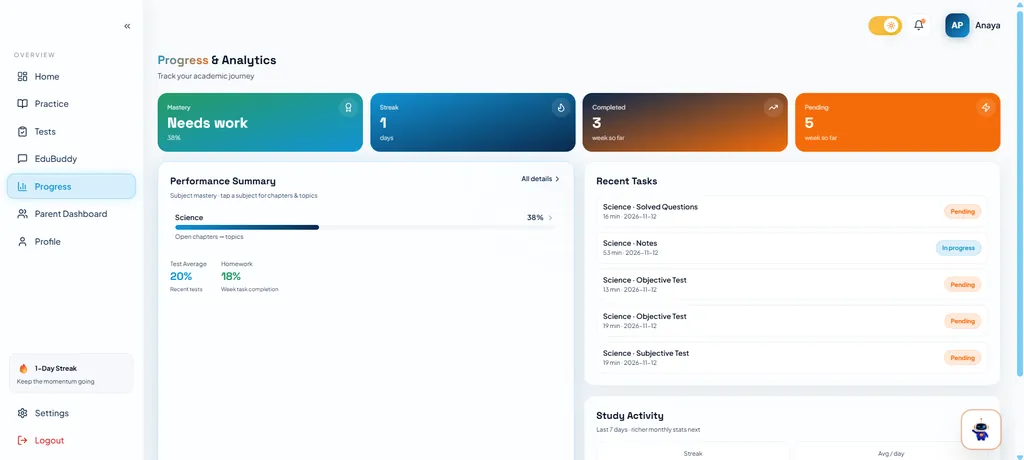
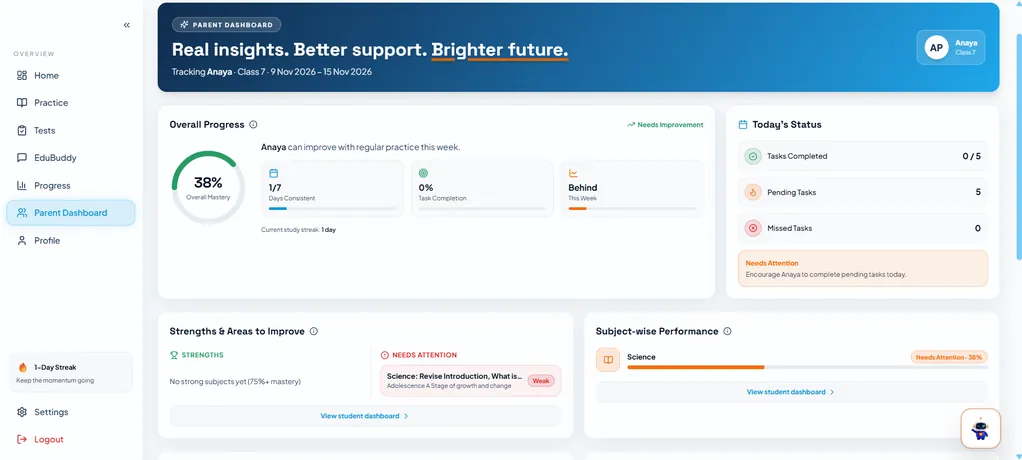
Read-only dashboards surface progress, readiness and weak areas continuously, replacing the pattern of parents learning about a struggling topic only after it appeared on an exam.
Product experience
Inside the product
Engineering
How it is built
The stack behind the build, layer by layer.
Architecture
Backend and Data
Messaging and Storage
Assessment and AI
Platform Services
Outcome
Results that changed the experience
The platform is moving through a phased rollout, so these are the behaviours the architecture was engineered to guarantee and the milestones the team is executing against rather than multi-year retrospective data.
Same-session personalisation. A graded test converts into a topic-level signal the moment evaluation finishes, so there is no lag between finishing a test and that result reshaping tomorrow's plan.
A daily plan that never goes stale. The ranking engine recomputes priorities for every active student every morning, so a topic that has quietly weakened rises back to the top without anyone noticing manually.
Topic-level visibility replaced chapter-level guesswork. Students and parents can see which specific topics inside a chapter need attention.
The app stopped drifting out of sync with school. The twice-weekly check-in cycle keeps each student's active chapter aligned with real classroom pacing, with lossless handling of interrupted chapters.
Written answers finally get real feedback at scale. Free-response answers receive AI-evaluated scores with written reasoning and a model answer for comparison.
Zero test-day downtime from AI outages. Graceful degradation ensures a test session still completes and objective results still arrive instantly if the evaluation service is unavailable.
A codebase that absorbed new modules without rewrites. Mastery, recommendation logic and the AI companion were added on top of Curriculum, Syllabus and Auth without touching their internals.
Roadmap execution on schedule. An internal pilot with roughly 50 students, parents and teachers validated the core experience, with the following phase targeting 1,000 early users on paid subscriptions and a school-facing version to follow.
The bigger picture
Why it matters
India's Grade 6 to 10 segment alone represents roughly 12.5 million students and a serviceable addressable market estimated at over $700 million, inside a K-12 segment that makes up more than 40% of India's $7.5 billion EdTech revenue. The market's dominant products were built to distribute content: video lessons, static question banks, generic test series. This project represents a category shift rather than a feature addition, from a content-delivery platform to a decision-making platform. Instead of asking what everyone should study today, the system asks what this student needs today, and answers it fresh, with evidence, every morning, at the level of individual topics. It also carries a broader engineering lesson: a system does not need microservices on day one to scale responsibly. What it needs first is disciplined module boundaries, explicit data ownership and event-driven communication.
Beyond launch
What comes next
The academic core of Curriculum, Syllabus, Task, Test and Mastery was deliberately built as a stable foundation for a much longer roadmap. New capability should extend the modules rather than compromise the boundaries between them. Planned and in-progress directions include:
What's next
- A school-facing portal with class and cohort mastery dashboards
- A deeper parent engagement layer and proactive progress insight
- Live classes and a learning marketplace on top of the engine
- Gamification that reinforces evidence-based study discipline
- Multilingual, regional-language content for Tier 2 and Tier 3 markets
- Voice and image doubt solving, and handwriting recognition
- Predictive readiness and early detection of disengagement
- Expansion beyond CBSE and ICSE, and beyond India
Start a conversation
Have an idea worth building?
Tell us what you want to build. You’ll hear back from our team, not an automated sequence.
- 01We review your brief
- 02A call with an engineer to scope it
- 03A proposal with timeline and budget breakdown